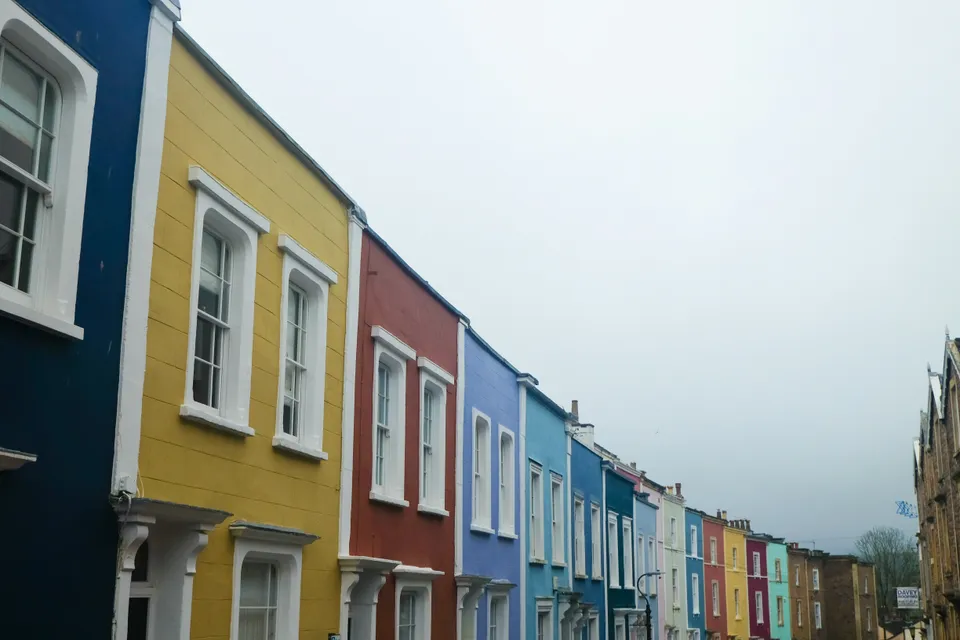
Bristol’s painted terraces are one of the city’s best-loved features. Totterdown’s hillside of pinks, blues, and mustards, the pastel rows near Clifton, the odd house painted deep charcoal or forest green to stand out from its neighbours: it’s a genuinely lovely thing to walk past. It’s also, on a hot July afternoon, quietly working against the people living behind those walls.
Colour isn’t just decoration. It’s a thermal decision, and in a heatwave it can be the difference between a bedroom that’s tolerable at midnight and one that isn’t.
1. Dark surfaces absorb, light surfaces reflect
Every surface has an albedo: the proportion of sunlight it reflects rather than absorbs. A wall painted white or a pale cream typically reflects somewhere around 70-80% of incoming solar radiation. A wall painted dark grey, navy, or charcoal reflects closer to 10-20%, absorbing the rest as heat. That absorbed energy doesn’t disappear; it raises the surface temperature of the render or brick, and from there it moves inward.
2. The difference is bigger than most people expect
On a sunny day, a dark-painted facade can reach a surface temperature 15-20°C higher than an identical wall finished in white. That’s not a subtle effect. It’s measurable with a simple infrared thermometer against two houses standing side by side, and it explains why the end house of a terrace painted charcoal often runs noticeably warmer than its pastel-pink neighbour, even though the layout, glazing, and orientation are identical.
In practice
Walking down a Totterdown street with a thermal camera on a summer afternoon typically shows a spread of 10°C or more across the row, driven almost entirely by paint colour rather than anything structural.
3. That heat doesn’t stay outside
Solid render or brick has thermal mass: it absorbs heat through the day and releases it slowly, including back into the house through the evening. A dark facade that’s 15°C hotter at 4pm is still radiating extra warmth at 10pm, which is exactly when people are trying to cool a bedroom down enough to sleep. This is a large part of why some houses on a mixed-colour street stay stuffy long after sunset while others next door don’t.
4. Bristol specifically has a decision to make
None of this is an argument for painting every terrace magnolia. The colours are part of what makes these streets distinctive, and there’s a reasonable case for keeping them. But it’s worth being honest about the trade-off: a deep-coloured facade in direct summer sun is very likely running several degrees warmer, on the surface and inside the top-floor rooms, than the same house finished in white or a pale tone would be.
For anyone renovating or re-rendering rather than simply repainting, that’s a genuine lever. Pale render on a south or west-facing wall, kept for the elevations that take the most sun, can meaningfully cut how hard a house has to work to stay comfortable, without touching the colours that make the rest of the street worth looking at.
The prettiest street in Totterdown and the coolest street in Totterdown aren’t necessarily the same street. Worth knowing before the next renovation decision, even if the paint chart wins in the end.