“It feels cooler with the shutters closed” is the kind of claim that’s easy to believe and hard to act on. It doesn’t tell you how much cooler, whether it’s worth the cost of doing the same thing to every room, or whether a cheaper measure would get you most of the way there. Two inexpensive tools turn that feeling into a number: a probe or infrared thermometer, and a thermal imaging camera. Neither requires any building work, and both can be used on a house you don’t own yet.
1. Start with a thermometer, not a camera
Before spending money on a thermal camera, a £15-20 infrared thermometer (the kind used for cooking or DIY) will get you most of the useful data. Point it at a surface and it reads that surface’s temperature in a second, which is enough to compare a shaded window against an unshaded one, or a white wall against a dark one, on the same afternoon.
The measurement that actually matters is surface temperature, not air temperature. A room can feel warm from radiant heat off a hot window or wall long before the air itself has caught up, and a thermometer aimed at the glass or the plasterboard beneath it will show that difference well before a room thermostat does.
2. What to actually compare
Random readings are hard to interpret. Structured comparisons aren’t:
- Same window, shutters open vs. closed. Take a reading at 3pm with the shutters open, then close them for 20 minutes and take another. The glass and the wall just inside it are what to measure.
- Two similar rooms, one shaded and one not. If only one room has external shading fitted, compare its window and inside wall against an equivalent room elsewhere in the house.
- Same wall, different times of day. A west-facing wall or window usually shows the clearest before/after difference in the late afternoon, when solar gain peaks.
In practice
A typical result is a glass surface 10-15°C cooler with external shutters closed than with them open on the same afternoon, and a shaded room settling 2-6°C lower at its peak than an unshaded equivalent — in line with what we see across most homes we assess.
3. Where a thermal camera adds something a thermometer can’t
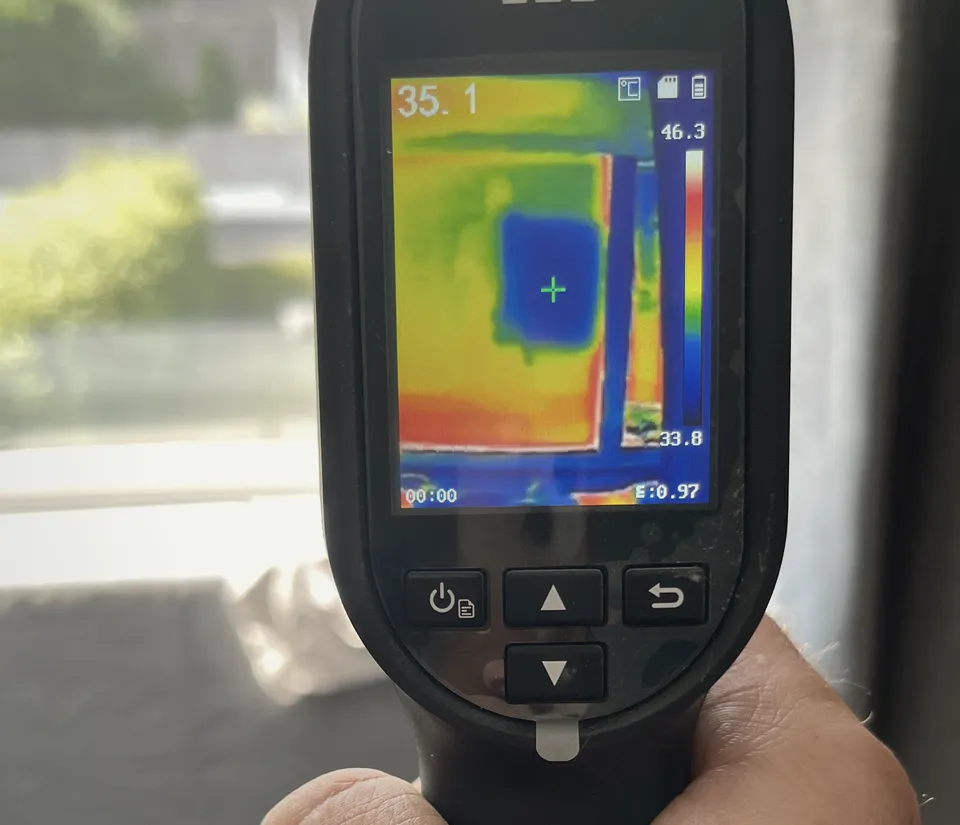
A thermal (infrared) camera turns the whole scene into an image instead of a single number, which is useful for two things a spot thermometer can’t do well: spotting where heat is getting in that you weren’t expecting, and comparing a whole facade at a glance. Clip-on thermal cameras for smartphones are now inexpensive enough to buy for a single project and resell afterwards, and they don’t need any technical knowledge beyond pointing and shooting.
Walking around a house with one typically reveals things a thermometer alone would miss: an uninsulated lintel above a window glowing warmer than the wall around it, a roof space radiating heat long after sunset, or one elevation of the house running consistently hotter than the others regardless of what’s fitted to the windows.
4. Reading a thermal image without being misled
Thermal cameras measure surface temperature, not “how hot something is” in an absolute sense, and a few things commonly trip people up:
- Reflective surfaces lie. Glass and shiny metal often show a reflection of the sky or the photographer rather than their own true temperature. Treat glass readings as approximate.
- Emissivity varies by material. Painted render and brick read fairly accurately on default settings; anything shiny or metallic won’t.
- Relative comparisons are more reliable than absolute ones. Trust “this wall is 8°C hotter than that wall” more than you trust the specific numbers either wall shows.
- Consistency matters more than precision. Take before-and-after shots at the same time of day, from the same distance, in similar weather, so the comparison is fair.
5. Turning the numbers into a decision
The point of measuring isn’t the number itself, it’s what it tells you to do next. If a thermometer shows a 12°C swing on the glass with shutters closed but the room air temperature barely moves, ventilation or airflow is probably the bigger bottleneck in that room, not shading. If a thermal camera shows one elevation of the house consistently running hotter across every window, that’s the elevation worth prioritising for shading first, rather than treating every room the same.
This is exactly the kind of evidence we use during a home assessment, and it’s just as useful done informally with a £20 thermometer on a sunny Saturday afternoon. Measure before you spend money on the next layer, rather than after.