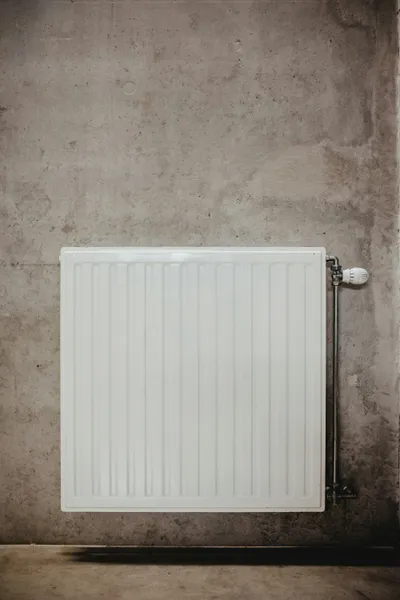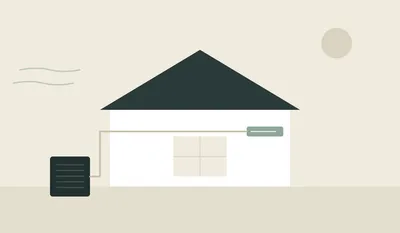
Picture a portable electric heater, the kind you’d wheel into a cold spare room in January, plugged in and running flat out on its highest setting. Now picture that same heater sitting in the middle of your living room in July, switched on, all afternoon, every sunny day. Nobody would do that on purpose. But if you have a decent-sized south-facing window with no shading, that’s roughly what’s happening anyway.
1. The maths behind the claim
On a clear day, the sun delivers around 1,000 watts of energy per square metre to a surface facing it directly. A typical double-glazed window lets through somewhere around half of that as heat, depending on the glass. Take a fairly ordinary set of south-facing patio doors, about 3.6 square metres of glass, and multiply it out: 1,000 W/m² x 3.6 m² x 0.55 comes to just under 2,000 watts. That’s not a worst-case figure for a huge glazed extension. It’s an everyday set of patio doors on an average bright afternoon.
2. What 2kW actually means in a house
A standard plug-in electric convector heater, the sort found in most UK homes, runs at 2kW on its top setting. It’s usually enough to noticeably warm a whole room within twenty minutes. That’s the exact amount of heat those patio doors are putting into the room, except the sun doesn’t come with a thermostat or an off switch, and it keeps that output going for hours at a stretch through the hottest part of the day.
In practice
A 2kW heater run continuously for six hours uses about 12kWh of energy, roughly £3-4 on a typical UK tariff. An unshaded south-facing window delivers the same amount of heat into the room for free, which is exactly the problem: there’s no bill to notice it by, so it goes unaddressed.
3. Why air conditioning alone doesn’t fix it
This is the part that trips a lot of people up. If a room has the thermal equivalent of a 2kW heater running in the corner, and you switch on a portable air conditioning unit to cool that same room, the AC unit is now fighting the heater rather than cooling the house. Most portable units only manage 2-2.5kW of actual cooling capacity once real-world losses are accounted for, so a fair chunk of that capacity is being spent purely to cancel out heat that a blind could have stopped from entering in the first place.
Trying to air-condition a room with an unshaded south-facing window is a bit like trying to cool a kitchen with the oven door left open. The unit isn’t broken and it isn’t underpowered, it’s just being asked to do a job that’s twice as hard as it needs to be.
4. Shade first, cool second
External shading, a blind, shutter, or awning fitted outside the glass, stops the bulk of that solar radiation before it ever reaches the window. Blocking it there rather than with an internal blind or curtain is what makes the difference: internal shading still lets the heat in, it just diffuses it once it’s already in the room. External shading can cut solar heat gain through a window by a large margin, turning that 2kW heater into a fraction of its output before it ever gets going.
Once that’s done, any air conditioning or fan you do run has an actual chance of keeping up, because it’s cooling a room rather than racing a radiator that never switches off.
The households seeing the biggest difference this summer aren’t necessarily the ones with the most powerful cooling units. They’re the ones that worked out which of their windows had effectively been left on as a heater, and did something about it before reaching for the plug.